If Our Creatives Don't Pay For Themselves, Increase Your ROAS, Or Lower Your Cost-Per-Client Within 30-Days, You Get A 100% Refund
Get more clients cheaper. Guaranteed.
We pull your baseline: your ROAS, your Cost-Per-Client, which of your creatives died, and what is working.
We script and edit 25 creatives: the direct offer ads, the proof ads and the education ads.
They run as one sequence inside your Meta ad account, across the 9 to 10 touches your buyer takes.
You pay less per client. Your ROAS goes up.
The First Batch, Pays-For-Itself and Results guarantees. Any one of them missing gets you a 100% refund.
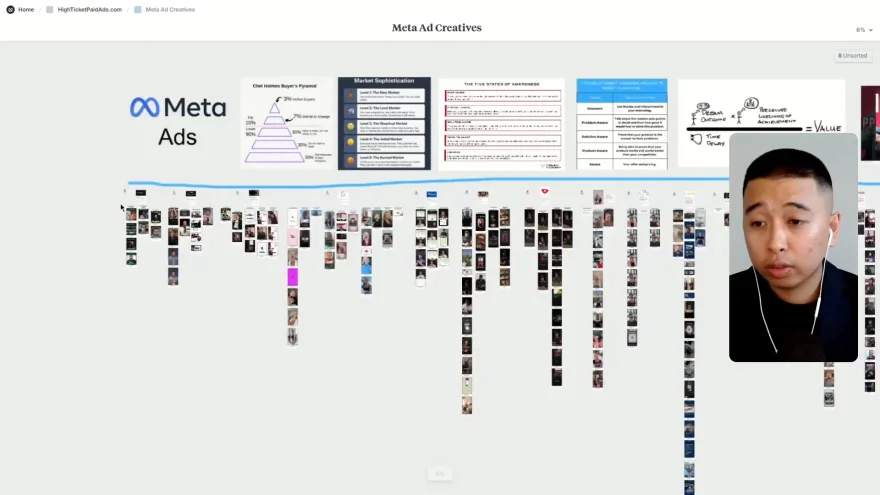
Everything we install, explained in full: the ecosystem in writing, and the 3 ad concepts inside it on video, with live examples.
What the whole thing is and why it produces clients.
In 2026, every advertiser from beginner to expert knows the creative is the most important part of getting results with Meta ads. The useful part is why that is the case.
Since the dawn of advertising it has always been two things: the creatives and the targeting.
Direct mail in the 1900s. TV ads. Billboard ads. Alongside the creatives, advertisers picked what address to send to, or what city, or what area, or what channel. That was their form of targeting.
The targeting still has to be right. Which TV channel it runs on, which zip code the mail goes to, which stretch of road the billboard sits on. But the creatives are what matter most, because you can get all of that right and still not do anything well with it.
The creatives are the marketing.
Meta advertisers used to pick who to send their ads to. It worked, and Meta set out to do it better, the way we all do over time.
So after years and billions of dollars in advertising, they decided they might as well control the targeting themselves.
On the media buying side, with the buttons inside your Meta ad account, an advertiser can no longer pick who gets targeted. Location still holds, and so do minimum age, language, and who you exclude. Past that an advertiser can only make suggestions, like a cat interest or a business interest. Advertisers get it wrong sometimes, and Meta would rather do it itself, because Meta has the most data.
So the creative is the targeting. What the ad says and who it says it to are now the same decision.
And it goes deeper.
In November 2024 Meta rolled out sequence learning. That is Meta's own name for it, published by their engineering team as Sequence learning: A paradigm shift for personalized ads recommendations, 11/19/2024.
Sequence learning is the sequence your ads are structured in. The flow of your ads, in order, that ends in a converted buyer. Meta stopped scoring each ad on its own and started optimizing across the ORDER: it serves one, then another, watches whether the conversion happened, and learns which order works.
So it is not about finding that one ad and repeating it. It is about the sequence of ads.
At HighTicketPaidAds.com we call the whole set of a business's ads working together the Ads Ecosystem. The Meta Ads Creative Sequence Ecosystem is the version of it we script, edit and launch inside your Meta ad account: the direct offer ad, the education ad and the proof ad running together as a sequence rather than as separate ads.
It is not our invention. It is the pattern already running in the Meta ad accounts of $1M+/mo Meta advertisers, and we build it for you.
Nobody makes a significant decision off one thing they saw once. It is the same way you decide anything online. You do not watch one video from somebody and decide they are who you will learn from. You watch a few, on different things, and you form a view.
According to Hyros.com, an ad tracking software with over $5 billion in ad spend tracked across 5,000+ users: today's customers interact with brands across an average of 9 to 10 touchpoints before converting.
https://hyros.com/updates/multi-touch-attribution/
And according to Google, in their Zero Moment of Truth research: the average shopper used 10.4 sources of information before making a decision, up from 5.3 the year before.
https://www.thinkwithgoogle.com/_qs/documents/673/2011-winning-zmot-ebook_research-studies.pdf
And this is not seeing the same ad 9 or 10 times. People are shown something different each time.
One ad teaches them something about their situation they did not know. Another shows them a business exactly like theirs that already got the result. Another simply says what the offer is.
Which is why Meta rebuilt its system around the order rather than the single ad.
It is also why retargeting mostly happens by itself now. Advertisers used to build the audiences and run separate retargeting campaigns by hand. That work sits inside the system.
If you have ever tested their algorithm in real time, the feed is instantly, stalkingly accurate.
Take the news. Once you have watched a video about a story, the system knows you have the context, so it starts showing you the supporting news around that story. It does not lead with the supporting pieces: it waits until you have watched the main thing.
Ads work the same way. Meta reads how people respond to each creative and serves each person whatever fits where they are right now.
Take Daniel Iles at Viral Coach, an agency estimated at $4M/mo, whose ads are public in the Meta Ads Library.
If his Meta ad account only held his direct offer ad, the one that opens "We will get you a million views or you don't pay. And if you give me fifteen seconds, I'll explain exactly how this works", how likely is a viewer to convert off it? Very unlikely.
So put a long-form client breakdown ad beside it. He runs one. If the first ad got a viewer's interest, they watched it through, they checked out his page, and they still did not book, the question is what is still missing. What else has to be true for that prospect to become a client?
So put an education ad beside those two. His is the Dan Trinati breakdown: an insurance agency owner, the problems, the strategy, what happened, the results at 24 hours, and the long-term strategy. What a prospect actually has to know before committing. Booking a call is a big commitment.
And then the proof ad. His opens "Here's what happened to a few clients after ninety days of working with us. A defense attorney went from three hundred and forty four followers to two hundred and thirty thousand followers, ranked in the top four percent of lawyers on social media worldwide." All in on client results.
Now how likely is that prospect to convert? Far more likely than off the direct offer ad alone. And the alternative, the same single ad again and again, is how a potential client gets annoyed, scrolls off, and is lost.
This is what "creative diversity" means when $1M+/mo Meta advertisers say it. The sets of different ads all working together, doing different jobs toward the same goal, which is signing a client. A different argument each touch, and any touch can be the one that converts.
There are many creative concepts you can run, and they all stem from three:
The Direct-Offer Ads. Here is my offer.
The Proof Ads. Here is proof it works.
The Education Ads. Here is the education of the offer or the situation.
There are really only three jobs an ad can do, and the concept names the ad's main job.
Three things to hold while reading the other three pieces.
An ad is always an ad. Whatever the main job is, the ad still sells.
The concepts overlap on purpose. One ad can carry the whole argument at once, and plenty of the ads we break down sit in two of them at the same time.
Proof runs through all three. Almost every ad leverages proof and client results somewhere. What makes an ad a Proof Ad is how heavily it leans on it.
That depends on your market, and it is a judgment per market rather than a formula.
Two facts about markets decide it, both from Eugene Schwartz in Breakthrough Advertising.
Awareness. Every buyer sits at a different distance from buying. Some only know the problem. Some know solutions exist. Some are close to ready. Every level is in the feed at the same time, and there is no single journey through them. To get the results we are after, the ad has to meet the person where they already are. A market that already knows solutions exist does not get taught the problem again: it gets the strategy, what we do differently, and why it produces more than what everyone else is offering.
Sophistication. How many claims like yours the market has already heard. Sophistication, awareness and trust levels have all risen, so a bold claim with nothing behind it stops working. Buyers have heard bold claims before, and they can tell when they are being shown only the best case. So every claim carries its how and its why.
What that changes:
Your Meta ad account holds all of them at once, so whoever an ad reaches, something fits where that person is right now.
The algorithm reads the creative and decides who sees it. It sequences the ads and learns the order. And every ad is doing one of three main jobs.
That is The Meta Ads Creative Sequence Ecosystem, and it is what we script, edit and launch inside your Meta ad account.
Every ad carries an offer somewhere. Direct-Offer Ads state it outright instead of arriving at it: here is what your business gets, here is the guarantee, here is what to do next.
The full shape is four parts. The ad says the offer out loud. It explains how the offer actually works. It gives proof. Then it asks for the click.
And it is a concept, not just an opener. The ad does not have to carry the whole argument by itself. The most common shape states the offer, spends the rest of its time on proof, and hands the educating to the VSL behind the click. Some carry the education and the proof inside the ad anyway.
It puts the whole offer in front of the buyer who is ready for it. Nothing has to be built up to first, which is why a Direct-Offer Ad can start the whole funnel on its own.
The buyer who is ready now. Right business, right problem, and the offer is what they are already looking for.
The straight offer statement. State it, guarantee it, ask.
Example: "We'll fill your calendar with 30 qualified sales calls in the next 30 days, or you don't pay."
Offer into proof, then the VSL does the educating. Offer and guarantee up front, proof through the middle, and the ask is to watch the video on the next page.
Example: the offer in the first ten seconds, then three client results back to back, then "watch the short video on the next page and we'll break down exactly how it works."
The result they already desire. The offer framed as the outcome instead of the mechanism. The desire leads and the mechanism trails.
Example: "One setter took this consultant from $40k to $100k a month," rather than "we install an appointment setting system."
Qualify first, then promise. The filter on the front, the offer behind it.
Example: "If you're a coach past $20k a month and you're still taking every sales call yourself, here's what we'd do for you."
The niche doorway. The same offer re-shot per industry, per job, per income band. The doorway swaps and the offer stays, which is also the clearest instruction Meta can be given about who to go find.
Example: one script, three cuts. "If you run a med spa..." / "If you run a law firm..." / "If you run an agency..."
The compressed VSL. The whole argument in one ad: the offer, the client results, then the full mechanism before the ask.
Example: a three to four minute ad that could have been the landing page video, running as the ad itself.
The risk-reversal front. The offer stated as what your buyer risks, which is nothing.
Example: "Try the team for two weeks. If you don't like what you see, you don't pay."
The "if I were you" shape. The founder stands in the buyer's position and says what he would do. It arrives as advice rather than as a pitch.
Example: "If I were a consultant sitting at $30k a month trying to get to $100k, here are the two things I'd do first."
These are not our clients. Every ad below belongs to another advertiser and is public in the Meta Ads Library, so you can open it and watch it running yourself.
Closers.io, a service provider estimated at $30M/year. The ad opens "One appointment setter is all it took to take this business owner to a hundred thousand a month", then states the offer: a proven appointment setter placed inside your business, and if they don't perform, you don't pay. Then the ask, click the link and watch the short video on the next page. Then the proof, over four thousand clients, names like Tony Robbins and Todd Brown. Then the logic: the largest recruiting agency in the online space, 150 to 200 setters and sales reps placed every month, ramped into the client's KPIs, then managed and grown.
What Closers.io does that most advertisers do not. A strong hook opening on the desired result and the direct offer. Then the proof. Then how it works, which is the part that explains why the offer is possible at all. It is labelled a Direct-Offer Ad, and proof and education are both connected inside it.
The same ad, different hook. "Thirty appointments in thirty days. That's what a single appointment setter can produce for your online business." Same ad body. And a third cut opening on the qualifier, "If you're seeing this video and you are a coach or an agency owner and you need sales calls on your calendar", then the offer, then the two reasons: their company grew from zero to three million a month in sales with their own sales team in 26 months, and they have helped over five hundred other sales teams. These are running right now, not old ads.
Daniel Iles at Viral Coach, an agency estimated at $4M/mo. "We will get you a million views or you don't pay. And if you give me fifteen seconds, I'll explain exactly how this works. First, we build a tailored strategy for exactly what's working in your niche, and then implement a content system that..." The offer, then straight into the education of exactly how it works, first, second, third. He runs the niche doorway version of the same thing: "If you're a chiropractor looking to grow your practice, we'll get you a million views on social media or you don't pay", and "If you're an attorney struggling to get new clients..."
Hyros, a SaaS estimated at $10M-$25M/year, founded by Alex Becker. "This will double your ad revenue. It did for at least Tony Robbins right here. Would you like that too? Of course you would. Our tracking AI Hyros will do that for you or you do not pay for it. Yes. Really." Then all the way in on proof: over five thousand businesses, Tony Robbins.
VSL Queen, an agency estimated at $10M/year. "Last month, we duplicated this guy's ad funnel with a female in all the creative, and he doubled his return on ad spend. At VSL Queen, we script, film, edit, and produce your next twenty winning ad creatives entirely done for you in seven business days." Then the proof. The same offer runs through a niche doorway too: "Bathroom remodel companies. If we offer to script, film, edit, and deliver your next twenty winning ad creatives in the next seven days, all one hundred percent done for you so you never had to film another ad yourself, feel awkward on camera, or blend in with your competitors, would you take us up on that offer?" Then the proof, then a short piece of education on trust, credibility and authority, and the result: homeowners started seeing them as the household name in their area and the only logical choice over their competitors.
An ecommerce email marketing agency. "Twenty two beautifully designed emails for your ecommerce business for a complete one time payment. Now these are not just random emails." Then what is in the twenty two, then the proof.
A body transformation offer. "Would you pay ten thousand dollars to never wear a T shirt in the pool again? Because that's the offer. I'll get you ripped or you don't pay. All of these men took that bet." Then straight into proof, then problem agitation.
A YouTube agency. "Growing your business on YouTube is easy, actually. Five thousand dollars a month, and we run the entire thing for you. The research, the ideas, the scripts, the editing, the thumbnails, exactly what you're getting. And if you don't love it, then you don't move forward." Then the proof.
Kettlebell Transformation, a coach, number one in its niche. "If you're a high earning dad, I will buy you your kettlebells, coach you from home, and if you don't drop at least twenty to thirty pounds, I'll just give you all of your money back." Then the proof.
A business opportunity offer. "I am going to teach you how to start an AI assisted agency, where AI does eighty percent of the client work, and you keep eighty percent of the money. You don't need a team." Offer first, then more educating than the others carry, because the market is beginner business owners, then the proof.
The offer, then the evidence, then the rest. Open on the problem, state the offer, then stop and hand over the evidence, then carry on with the ad. Naming a few client results at that break is the version we write. Holding the proof until the close anchors nothing, because the claim and the offer have already gone past somebody who had no reason yet to believe them.
A direct offer with no evidence behind it is the weakest ad there is. A lot of advertisers run direct offers with nothing supporting them, and the viewer does not trust what is said. Sophistication, awareness and trust have all risen, and buyers ask how a bold claim actually works before they believe it. Sometimes the offer alone is all a market takes, and that is rare now.
Explain the logic. The viewer has to understand, to a certain degree, how your offer works before they believe in it. If your business is an ecommerce email marketing agency, the ad states the offer, gives the proof, and then explains what your strategy does differently: the copywriting difference against other email marketing services, or what the ecommerce brand is not doing right now. That education is what makes the offer credible rather than loud.
Where the ad ends depends on your market and your offer. How much education and how much proof an ad carries is a judgment on the business in front of us, not a fixed order.
The offer is the strongest lever any business has, so this ad leads with the biggest thing your business owns.
It runs on the perceived likelihood of achievement. That is the confidence a buyer has that they will actually get the result, from Alex Hormozi's value equation. Hormozi is the founder of Acquisition.com. The more value a buyer perceives, the more likely they are to buy, and perceived likelihood of achievement is one of the parts that sets it. Explaining logistically how the offer works is what raises it.
Alex Becker's bar for an offer that works on cold traffic is five things at once: it is new, it gets results, it happens without effort from the buyer, it is proven, and it is guaranteed. The accounts that run this concept hard clear that bar inside the first fifteen seconds. A cold viewer learns what they get, what happens if it fails, and what to do next, before they have even decided whether to keep watching.
It is the most common shape across the accounts we broke down.
Almost every ad carries proof somewhere. Proof Ads make the proof the whole argument: they open on the result, a number, a client saying it, or the actual work on screen.
Proof is a strategy that runs through a whole Meta ad account rather than one ad style. Client results are proof of the outcome. Education is proof of competence. Explaining why the thing works is proof of the mechanism. This concept is the ad whose main job is the proof, and it is the default look of an account that is working.
Conviction. In one term, the perceived likelihood of achievement. That is the confidence a buyer has that they will actually get the result, and it is the number every proof ad moves. When it is high enough, working with your business reads as close to a guaranteed outcome.
Underneath it sits risk, perceived or real. There is risk in everything, and to the buyer, booking a call or taking an offer carries some, whether it is real or only felt. Proof shows them it is safe.
The qualified buyer who does not believe yet. Right business, right problem, an offer that exactly fits, and still not booking, because the conviction that this will work is missing. Shy, been burned before, on the edge.
It is cold traffic. Client results early in the ad anchor the trust early, and everything the ad says after that is easier to accept.
A cold viewer's guard is up, always, and it never comes all the way down. What proof does is lower it enough that the ad gets listened to. Their ears open, and they are willing to hear what your offer actually is. The proof anchors the credibility, and the argument lands on top of it.
Held to the end instead, the claim, the teaching and the offer all sit there with nothing holding them up.
The client carries the whole ad. The founder is barely in it, or not in it at all. The client talks, and it usually opens on their number.
Example: a client on camera opening with their result, and the founder never appears.
The testimonial cold open. Fifteen to thirty seconds of client footage on the front, then the founder takes the rest. One pitch, interchangeable client fronts.
Example: one founder script, three different clients welded onto the front of it, running as three separate ads.
The case study. One client, start to finish. It runs long on purpose and short on purpose too, and the same filming session gets cut both ways.
Example: one client interview cut into a six minute version and a forty second version.
The results wall, and the artifact on screen. The number is not spoken, it is shown.
Example: screen-recording the Meta ad account, or scrolling the client's own dashboard down to the revenue line.
The "you haven't booked yet" ad. Proof aimed at the person the rest of the set already reached. It also runs as a single line inside an ad that already exists, which costs nothing.
Example: "You've seen our ads and you haven't booked a call yet, which I get. So here's what happened for six of our clients this month."
The reasons-why ad. Not client results, but why your business is the one to choose.
Example: "In the next sixty seconds I'll give you three reasons you should book a call. Not necessarily work with us, just book a call to see what we have to say."
These are not our clients. Every ad below belongs to another advertiser and is public in the Meta Ads Library.
Closers.io, a service provider estimated at $30M/year. The ad opens by naming what the viewer already did: "Hey, so this is getting really awkward. You've seen a bunch of our ads already, and for whatever reason, you haven't booked a call. So what I'm gonna do is I'm just gonna scroll through some of our client wins over the last two to three weeks." Then it does exactly that, from about thirteen seconds through to four minutes. Four minutes of nothing but proof.
The same business, the reasons-why version. "You saw one of our ads about us being able to place a setter or closer in your business or you don't pay, but you decided not to book a call, which I get. I'm sure you see dozens and dozens, if not hundreds of ads on your feed on a daily basis. So in the next sixty seconds I'll give you three reasons why you should definitely book a call. Not necessarily work with us, but just at least book a call to see what we have to say." Reason one is the track record. A different form of proof, aimed at why you would choose them.
Daniel Iles at Viral Coach, an agency estimated at $4M/mo. "Here's what happened to a few clients after ninety days of working with us. A defense attorney went from three hundred and forty four followers to two hundred and thirty thousand followers, ranked in the top four percent of lawyers on social media worldwide right now. A homebuilder..." Client results, stacked, one after another.
Hyros, a SaaS estimated at $10M-$25M/year. A compilation of client testimonials, run back to back. "The first one I recommend is Hyros, h y r o s." Then more of the same, and the ask at the end.
Tridas Marketing, an agency running 120 ads. A live client call: "We're nine hundred dollars short of two hundred thousand. My year to date looks pretty dope, dude. We're at two hundred raw leads, ninety of them set, sixty six issued, fifty three..." What Tridas does better than most: structure. A client testimonial video is usually long and unstructured. Theirs leads with the desired result and is cut tight. And the branding and colour are on the creative, so the viewer knows whose ad it is. Their other cuts run the same way: "Twelve projects, two hundred k closed", and "Kabrin here is running a three person agency and is on pace to make a hundred and fifteen thousand dollars in a single month. Three people. That's it."
VSL Queen, an agency estimated at $10M/year. A live client call on screen, with their logo burned on, so a viewer instantly knows it is the same business whose ad they saw before. Most advertisers put nothing on the screen at all, which is a loss.
Kettlebell Transformation, a coach, number one in its niche. "We've spent about fifty k, and we've made about four hundred and twenty eight. We've got four kettlebells." And the comparison cut: "While you cut out sugar, eat clean, and train seven days a week and still look average, these guys got ripped by doing less."
An ecommerce email marketing agency. Real work shown on screen: "This email flow doesn't just look amazing, but it actually converts for this business. Just take a look at this brand. They were stuck at a hundred and thirteen thousand dollars a month. And within thirty days of us implementing our system..." Then the number: "As soon as we implemented our email flow system into their business, we did a hundred and forty six thousand dollars. We increased their sales by thirty six percent." He is live-recording the actual emails on screen while he says it, which is what makes it land.
A YouTube agency. "This business owner was getting thirty views of video on YouTube, and now he's the number one YouTube channel in his entire niche, which is Facebook ads. He makes over four hundred thousand dollars per month from it. Now the way that we did this for Sam was simple." Proof into education, which is a pair that goes hand in hand.
Revolutionary Weight Loss. A straight client testimonial to camera.
A fitness offer. Opens on the client: "When I started it, I was at my maximum weight ever. My lifestyle was a little bit nuts." Then the problem, then more proof, then the offer. It opens on the testimonial, and that is what makes it a Proof Ad.
Not only cherry-picked. Showing nothing but the best, most perfect client results is not relatable, and consumers and B2B buyers both recognise cherry-picking now. The correct version shows all forms of proof: results from their industry, the most average, the most relatable. The mix depends on your offer and your market.
Burn the logo and the result on screen. Without the overlay, a testimonial is a random person talking with no context, and the viewer has to sit through all of it to learn anything. With the logo and the result burned on, it reads as a trailer of what is inside, and the person on screen reads as legitimate.
Structure the testimonial. Lead with the desired result rather than letting the client wander into it. Most client testimonial footage is long and unstructured, and that is the difference between footage and an ad.
Real footage of the actual thing is what convinces. Stock footage with a stranger holding a phone is the fallback.
Lead quality counts as proof, not just volume. What a business actually pays for is not cheap leads.
Alex Hormozi, founder of Acquisition.com, reviewed 2,000 ads. Of the top 50, 40 were proof and 10 were educational, which he counts as an approximation of proof. Across all 2,000, only about a fifth were proof at all. His own conclusion in the clip: do more proof ads. What separates the top of the pile is evidence, not production value and not cleverness.
Johnson sent that clip with the note that proof style ads are one of the best performing concepts there is, and that Kevin O'Leary from Shark Tank has said the same.
And in a saturated market, proof is the only thing left to argue about. Where a market already believes in the channel, nobody has to be taught why it matters. What is left is whether your business can do it for them, and other businesses like theirs getting exactly what was promised is the answer.
Proof is the one thing a competitor cannot copy, because it belongs to your business's actual history.
The ad teaches. And what it teaches is not one thing.
Educating on the problem is only the first form, and it is the form nearly every advertiser defaults to. There is also educating on the offer and how it actually works. Educating on their situation and the reasons they are in it. Educating the pain. And educating on why the offer works at all.
There is also objection-led education. If your market holds a false belief that is limiting their result, the ad teaches why it is false. That objection comes off your own sales calls, and the ad answers it out loud.
It teaches something true and earns the attention to do it. The teaching is the ad.
The widest range of the three, and the earliest.
Pointing at a problem only works on somebody who already knows they have it. Being told they are doing it wrong stops somebody who does not. And the forms that teach the offer or the mechanism reach much further along, all the way to somebody comparing options.
Educating on the problem. What they are doing is wrong. The contrarian line is the hook that earns the right to teach.
Example: "Stop running lead magnet ads for your coaching business."
Educating on the offer. What is inside it, how it works, what the process is, step by step.
Example: "Week one we build this, week two we launch that, and by week four you have this."
Educating on their situation. Their own circumstances explained back to them, often better than they could explain it themselves.
Example: "Here's why your close rate drops the moment you push past $10k a month on ad spend, and it has nothing to do with your closer."
The money math version does the arithmetic on camera and lets the viewer finish it. Nobody argues with a number they just calculated themselves.
Educating on why the offer works. The mechanism taught as a lesson, with the offer as the landing rather than the subject.
Example: explaining why the algorithm serves a set of ads rather than one, and only then naming what your business builds.
Old way against new way. The same concept with a time axis on it. It names competitors out loud without attacking the viewer.
Example: "The old way was one ad pointed at a landing page. The new way is a set of ads each doing a different job."
The objection-led lesson. Opens on what they are already thinking, then teaches out of it. Conceding first is the move, and the objections have to be real ones from real sales calls.
Example: "I never said you can't run your own ads. You can. Here's what changes once you're past $50k a month."
The long lesson. Four to nine minutes, almost entirely teaching, and it still ends on the ask. Almost nobody watches it, and the few who do arrive already convinced.
Example: the whole method drawn out on a notepad and given away in full, then the ask.
These are not our clients. Every ad below belongs to another advertiser and is public in the Meta Ads Library.
Daniel Iles at Viral Coach, an agency estimated at $4M/mo. The long-form client breakdown education ad, running 8 minutes 52 seconds: "This is how we took Dan Trinati, an insurance agency owner, from struggling to needing to hire more agents in just three..." He educates on his offer, which guarantees a million views. He educates on the problem the client had. He goes into the strategy they used, then the results at 24 hours, then the long-term strategy play. Then the ask. It is a Proof Ad and an Education Ad at the same time, which is what the overlap looks like in practice.
Two shorter cuts of the same idea. "This is how we took this three thousand view video and got our client two hundred thousand views." And "This got him four hundred thousand views on literally the same exact video. And if you're doing podcasts and if you're cutting up clips, this is why you're stuck at a few hundred or a few thousand." Very specific in the strategy, which is what makes the education land.
An ecommerce ads agency. "If you run e com meta ads right now and you're not scaling hand over foot, I wanna show you how we scaled one of the largest ecommerce watch resellers online, Luxury Bazaar, and blew up the ROAS in their account just by fixing a little piece of AI data." Then the old-model problem and the new solution: what is broken in 95% of the ecommerce accounts they see, and what they did about it, with the tracking data difference shown on screen.
Karlton Dennis, tax advisory, with a $1M+ client tax refund. "Let me show you how you can get a million dollars back." He is a tax strategist, and he puts the actual return on a whiteboard. Real paper documents, real numbers, and what happened after. Visual demonstrations are what make an education ad work. A Zoom screen share does the same job with less production.
VSL Queen, an agency estimated at $10M/year. The offer-information education ad: "So what's it like to get done for you ad creative for your business made by VSL Queen and the team?" She walks through what it is like to work with her: the real examples, what to expect, and then the process. "Any winning ads you've run or ideas you've seen your competitors use. Next, we will handle all of the creative strategy and scripting." And she leverages proof inside it, because the proof is what makes the viewer willing to listen to the rest.
An email marketing agency. The same shape aimed at a comment: "This person commented, what flows are you building out for my business? So this is the entire sequence that we are actually building out for your brand. Inside of all, my team handles everything."
A YouTube agency. Educating on the offer and on the mechanism at once: "Here's exactly what happens when you book a call with us to grow your business on YouTube, because we don't really pitch you, to be quite frank. We research your niche live and show you the videos that we make for you. The actual titles, the concepts, why they'd work for your buyers." Then the secret sauce: "Here's something most businesses don't realize about YouTube. The video that's about to blow up for you has probably already blown up in a completely different niche. That's the actual game of YouTube."
A painting company's agency. "Here's what most painting companies are running as Facebook ads." Then the problems with it.
A sales training offer, old model against new model. "So what's the difference between the old model of selling compared to the new model of selling? Typically, in the old model, the first ten percent of a sales conversation was building rapport, building trust. How are you doing today? How's the weather?"
The second half has to be there. Saying they are wrong with nothing behind it is noise. The claim has to be true, and the ad has to be able to back it. Manufactured contrarianism is the same failure as fake scarcity, and neither goes in.
And it does not get rushed. An ad that names a mechanism and moves on has left the viewer with the interesting part missing. The fix is a longer ad, not a tighter one: more on why the mechanism works, and more on why the existing solutions are not good enough.
Show it, do not only say it. Real numbers, documents, a whiteboard, a screen share. A number that is spoken has to be believed. A number on screen inside a tool the viewer already uses is checkable.
Formats are not jobs. A podcast, an interview, a whiteboard, a comment reply, a phone selfie: those are the room the teaching happens in, not the job the ad is doing. Any format can carry any of the three concepts. And Meta serves formats to the people who engage with them, so an account made of one format reaches a narrower slice than it could.
Teaching does not mean no pitch. One account hands over its entire four-video method for free inside a paid ad, then asks. Another teaches the actual sales technique, then sells the book that holds the rest. An ad is always an ad.
What has to be true for your market to become a client?
Sometimes the answer is explaining how your specific strategy works. Sometimes it is a client breakdown that teaches while it proves. And sometimes no education is required at all, because the market already believes and the offer plus the proof is enough.
Not every market and not every offer takes education. It is a judgment on your business, your offer and your market.
Nobody else in the market is saying it. The test on an opening line is whether it has been run a million times already, and telling somebody to stop is the opposite of what everyone else is saying.
Education raises the perceived likelihood of achievement. A buyer can hear the dream outcome and the promise and still not believe they will get it. Education gives them the safe feeling of understanding how the offer works, why it works, and the logic underneath it. Proof and education are the two things that move that number, which is why an account carries both.
Education is also proof of competence. In Alex Hormozi's 2,000-ad review, the 10 educational ads in the top 50 sit beside the 40 proof ads, because teaching the mechanism proves you understand it. Hormozi is the founder of Acquisition.com.
These are the Meta ad accounts we broke down. The Meta Ads Creative Sequence Ecosystem is the pattern running across all of them, and it is the same strategies and principles we apply to script, edit and launch your Meta ad creatives.
These aren't our clients. This is to show you what's working for businesses doing $1M+/mo, why it works, and the common patterns we'll implement for you to help your business scale.
01A proven setter or closer placed in 7 days, or you don't pay if they don't book you 40 calls in month one.
It's mass-desired (every business wants salespeople) and dead clear to cold traffic, and the guarantee removes the exact fear that kills the sale - paying and getting nothing.
An offer-first ~5-minute VSL that opens with the offer, stacks proof (Tony Robbins, a $3M/mo solar company, Ryan Serhant, 2,000+ businesses), then shows how they hire and train the reps themselves.
The market already knows why it needs closers, so proof beats education - and showing the hiring makes the 7-day placement and guarantee believable instead of too-good-to-be-true.
580+ direct-response video ads with the offer and guarantee right in the creative.
Naming the offer self-targets the ad - only owners who already need salespeople respond - so the ad does the audience targeting, the volume gives Meta enough winners to keep scaling, and in a saturated, done-for-you market you win on this proof, not on educating or personal trust.
02High-ticket 1:1 fitness coaching for high-income men - “get ripped or you don't pay,” $150k+ income to qualify.
The guarantee removes the risk and the $150k+ gate means the offer only sells to men who can afford a premium, which is what lets a coaching offer scale.
A serious-toned VSL and a simple Typeform application that enforces the $150k+ gate before the call.
The gate filters out everyone who can't afford it before they waste a call slot, so the calendar fills with real buyers.
63 ads with founder John Madsen on camera, suit on and serious - the opposite of the usual fitness influencer - hitting pure pain at the exact buyer (“you have the car, the Rolex, the business - so why doesn't your body look like your business?”).
The serious positioning separates him before the offer is even made, and the pain messaging does the targeting: the men who engage teach Meta to serve it to more of the same.
03100% done-for-you paid ads and funnels with an ROI guarantee - the ads and funnel pay for themselves or you don't pay.
For a done-for-you service the buyer is paying for the result, so the guarantee plus proof is what closes them: risk off, results on.
A landing page (now testing a VSL) that's all proof - screenshots, client testimonials, stage footage - carrying the same ROI-or-you-don't-pay guarantee.
Proof and track record are exactly what a done-for-you buyer uses to decide, so the page is built to kill doubt that he can deliver.
~290 ads that lean hard on proof (Inc 5000, $35M in ad spend driving $148M for clients at a 4.2 ROAS, stage footage, testimonials).
His market is already shopping for an agency, so a straight offer + stacked proof + a little education + CTA converts without heavy teaching.
04A done-for-you and done-with-you organic content system for affluent owners (~$50k+/mo), guaranteed - a million views or you don't pay.
The guarantee makes the bet easy and the ~$50k+/mo target means it only sells to owners who can afford it.
No VSL - the older buyer won't sit through one - so the landing page does the job with big logos (Grant Cardone, Amazon, Skool, TurboTax), an easy form, and proof all the way down (case studies run to full before-and-after walkthroughs).
Deep proof builds the trust this buyer needs, and a plain page fits an audience that won't watch a video.
~1,200 ads across every concept (image, text-on-screen, text-only, 8-minute long-form) with different faces on camera, the guarantee leading every ad.
A done-for-you buyer just needs trust + proof + a guarantee, so leading with the guarantee sells, and many different faces reach more of the market (different buyers relate to different people).
05Included on purpose - his front end is a $27 book funnel, not a Call Funnel. His ads are the important part.
NEPQ sales training on a $27 “Black Book” front end that ascends into high-ticket team training.
The $27 front end is a near-frictionless yes that filters for real buyers, and his own named methodology (NEPQ) makes him his own market.
The $27 book funnel ascends into high-ticket team training, with a 57-60 minute training running to retarget everyone who watches.
The ads do the selling and the long training plus retargeting nurtures everyone not ready to buy yet.
All 93 ads are pure value - him on real sales calls or teaching a technique and handling the most common objections live, closing with “if you got value, I have a book for you.”
In the coaching world you win by proving you can teach, so giving away real, usable technique earns trust fast and acts like a cliffhanger into the book.
06“Script, film, edit, and deliver your next 20 winning ad creatives in 7 days, 100% done for you,” tiered from $5k+.
It solves a painful, specific problem - founders are business owners, not content creators - so a done-for-you creative team is exactly what they want to hand off.
A schedule-a-call VSL page, including a raw transparent version that screen-records real dashboards ($29k of spend to $541,885 in 28 days).
Showing the actual work and numbers gives the prospect the clarity, comfort and trust to book - showing beats telling.
~90+ simple, proof-led UGC ads where a client result is the hook and the offer lands in the first seconds, one winning script reused across creators and settings.
Amplifying proof is what earns cold-traffic trust in a saturated market, and reusing a winner across faces reads as fresh ads while keeping what works.
07Out of shape to “kettlebell beast” - drop 20-30 lbs or 8-12% body fat in 180 days or double your money back - with a named mechanism (the “Kettlebell Savage Protocol”) and no gym required.
The promise is dead simple so cold traffic knows exactly what they get, the named mechanism makes it feel tangible, and doing it from home kills the time objection.
A funnel page that's a proof wall of real client transformations and 4.9-star reviews, with the double-money-back guarantee front and center.
For a transformation offer, stacked proof plus a strong guarantee is what convinces cold traffic it'll work for them too.
100+ raw, phone-shot ads matched to a 30+ audience, 60-70% led by a client case study (CFOs, engineers, doctors), every ad qualifying hard on six figures and naming the guarantee.
Qualifying on income in every ad buys affluent buyers - which is what lets a B2C fitness offer scale - and leading with real case studies makes proof do the trusting.
08A $5k-a-seat, two-day in-person Scaling Workshop at the Acquisition.com HQ - “are you the thing limiting your business? Remove yourself as the single point of failure” - sold on a booked call, not a checkout.
The offer names one buyer and one problem, the founder who is his own bottleneck, so the ad does the qualifying before anyone clicks.
Meta ads to a VSL page to a booked call, with the qualification printed in the FAQ (“under $250k/yr this is not a fit (yet)”), the $5k price justified on the page, and the $250M/yr portfolio, reviews and a walkthrough video stacked as proof.
Disqualifying in writing keeps the calendar on founders who can afford the seat, and the VSL plus the FAQ sell the $5k ticket before the call ever happens.
100+ active ads - talking-head videos and book-cover statics - running cold against the biggest organic brand in business media.
He has near-infinite options and still buys cold traffic to a VSL and a booked call, and the ad volume gives Meta enough winners to keep scaling the workshop.
09Three offers at three price points out of one Meta ad account: a done-for-you build of a full end-to-end client acquisition operating system, a lower-priced Skool program, and an offer that installs a seven-figure agency owner into the business as a fractional CEO. Each one carries a guarantee - if the systems don’t work, you don’t pay.
Three price points let one Meta ad account sell to buyers at three budgets instead of losing everyone who can’t afford the flagship, and the guarantee takes the risk off all three.
Direct-response ads straight to a booked call, with free-content ads teaching first. The ads carry the selling - the story, the education, the case studies and the guarantee all land before the click.
Giving something away first earns the attention the direct-response ads then convert, so the call gets booked by someone who has already been taught and already believes it works.
The account runs as one ecosystem: long-form story ads doing the direct response, free-content ads, short reminder ads on a different creative concept, image ads, and case-study ads. The story ads follow one build - open on a specific client or a famous marketer, name the exact problem of a $10k-$40k/mo agency owner working harder than he did at the start, give the education (it is a system problem, not a work problem), then the offer, then the proof (a client named Jaden now at eight figures, the same playbook run 4,000 times), then the guarantee.
Different creative concepts reach the same buyer without reading as the same ad twice, and running the account as one system - teach, remind, prove, then ask - is what stops scaling from depending on a single winning ad.
10Included on purpose - Hyros sells software on a subscription, not a Call Funnel, and the revenue is Alex Becker’s own public statement. His ads are the important part.
AI ad tracking that installs on your site in two seconds and attributes every sale back to the exact ad, on a guarantee: if it doesn’t lift your ad revenue by at least 15%, you don’t pay.
The guarantee names a specific number instead of a vague promise, so a cold buyer can judge the bet in one line, and a two-second install kills the last objection a busy advertiser has.
A proof-dense direct-response page: the guarantee at the top, a “see how it works for your business model” segmentation, then long walls of named testimonials and video case studies.
Tracking software is boring infrastructure, so the page has to prove other businesses got the lift - and segmenting by business model lets each visitor read the case study that matches his own situation.
Founder-led ads built 20% offer, 80% proof: the first seconds state the desire and the guarantee (“this will double your ad revenue... or you do not pay for it”), then roughly 50 seconds naming customers - Tony Robbins, Alex Hormozi, ClickFunnels, Playboy, 5,000+ businesses. Retargeting ads screen-record hundreds of customer posts on X, read out one by one.
Cold traffic doesn’t believe a claim about tracking, so the ad spends most of its runtime showing named customers and their numbers instead of repeating the promise - and leading with the desire plus the guarantee earns the watch time that proof then converts.
11Included on purpose - her front end is a free live weekly webinar, not a Call Funnel. The funnel choice and the ad messaging are the important parts.
The She Sells Academy program, roughly $3k-$5k, teaching women to move into high-ticket remote sales - sold off a free live masterclass that runs every Tuesday.
The offer speaks to one buyer only, women already working a full-time job who desire a way out, so everyone outside that description filters themselves out before they ever click.
Meta ads to a webinar registration page (curiosity bullets on what she’ll teach, “this is for you if / this is NOT for you if” qualification blocks, founder bio) to the live weekly webinar to the program.
Her buyer is new to the whole idea of high-ticket sales, so the live hour does the education and belief-building the sale requires - a cold jump from ad straight to a sales call would lose her.
~90+ active UGC-style video ads reworking one winning hook (“if you’ve got a phone, a quiet room and two hours free at night, you are already qualified”), naming the exact jobs she is speaking to - barista, bartender, nurse, teacher, stay-at-home mom - and promising $500 to $1,000 a day.
Naming the job does the targeting, and the smaller number is the one her buyer can picture herself hitting - a bigger promise reads as a scam and buys the leads who chase lottery tickets.
12Included on purpose - his front end is an opt-in to an hour-long free training, not a Call Funnel. The back-end selling system is what makes it pay.
Client Ascension - a program for building and scaling an AI-assisted marketing agency, with the deliverables printed on the page: five proven in-demand service models, pre-built AI workflows, a done-for-you client acquisition system, agency websites and contracts.
The deliverables give the logical answer to “how is this even possible” right next to the result being promised, and that logic is what a buyer checks before committing to a program.
Meta ads to an opt-in page, then an hour-long free training plus a VSL landing page carrying deliverables, a timeline, founder bio, FAQ and case-study screenshots, then a booked call - followed by a confirmation page of objection-handling videos (how do I get clients, how do I fulfill, what is the guarantee, a 1.33% refund and dispute rate shown on screen) and value-dense pre-call emails.
The hour of teaching earns the trust a program sale requires, and an opt-in front end only pays when the email system and the sales team work every lead it collects - his do.
Ads that open on a third-party statistic ($2 trillion spent on AI in 2026, $324 billion of it on AI services) instead of hype, say how he helps by the 30-second mark, then hand over to proof (three companies, 1,200 entrepreneurs scaled, ListKit valued at $48.6M) and send the viewer to the training. Retargeting ads carry more free training for anyone who watched and did not act.
A third-party number carries weight his own claim cannot, and the retargeting training keeps teaching a lead who was not ready instead of dropping him.
13A digital asset advisory membership in two tiers - Black Tier, a portfolio built one-on-one and gated in writing to investors with $1M+ in liquid net worth, and Platinum below it - sold by application and a “private review” call, with cohorts capped.
The printed $1M+ gate and the private-review language repel the unqualified and flatter the qualified, so the calendar fills with investors who can fund a position on the first call.
Meta ads to a VSL page with the application embedded on the page, then a booked private review call, then a confirmation page carrying objection-handling videos, then pre-call emails, SMS, and retargeting ads running those same objection videos at everyone who booked. The VSL educates before it sells - institutional adoption, the market conditions in real estate, why earlier crypto attempts failed, their own approach, the risk of doing nothing, then case studies.
A booked call is where the doubt starts, so the confirmation videos, the emails and the retargeting keep answering the objections a prospect will not say out loud - that is what turns an on-the-fence booking into a show and a sale.
The account runs as one system: direct-response ads asking for the call, case-study ads carrying client results, and a separate messaging angle per ad. One opens on real estate (“prices are sky high, but nobody’s buying”), another on bonds (“if you have a significant allocation to bonds in your portfolio, you need to hear this”), and the digital assets get introduced after the problem rather than in the hook.
His buyer holds real estate and bonds, so leading with the asset already owned and the problem already felt earns the watch, and a new angle per ad reaches several pockets of the same affluent market instead of one.
14Included on purpose - ListKit sits below the $1M+/mo mark and its front end is an opt-in, not a Call Funnel. How they run the Meta ad account is what transfers.
A done-for-you AI cold email system built in seven days - “book 10 to 30 sales calls per month by sending thousands of AI-personalized cold emails” - with the result, not the software, carried in the headline.
The headline promises booked calls instead of emails sent, and booked calls are the thing the buyer is paying for - a page that only names the mechanism gives a cold visitor nothing to buy.
Meta ads to an opt-in page, then a VSL landing page built as a slide presentation (~27 minutes) running how it works, proof, the offer, pricing and FAQ, then a Typeform and calendar to book, then a confirmation page carrying four-minute breakout videos - what to expect, will my emails bounce or go to spam, what is the commitment, who are you, is this worth the investment - with pre-call emails pointing back to that page.
The breakout videos are built from their own sales calls rather than a generic FAQ list, so they answer the doubts that actually kill the sale, and the pre-call emails keep sending the booked prospect back to them.
~120 active ads - mostly plain talking-head with almost no editing, plus whiteboard ads, image ads and case-study ads - each carrying its own angle: naming the competition (“Apollo and ZoomInfo only give you the data”), an offer hook (“how many sales calls could you book if you sent 100,000 cold emails every month with 99% deliverability?”), a client case study (19 deals closed in three months), and a hiring angle (“if you’re sick of hiring American SDRs”).
Each angle unlocks a pocket of the market the others miss - the SDR ad is small on impressions and it is the only ad reaching owners whose problem is a bad sales hire - and the volume gives Meta enough winners to keep spending. The ads win on what is said, not on production.
15High-ticket 1:1 coaching for women 40+ going through perimenopause and menopause, built on menopause-specific nutrition rather than a general macro plan, with 65+ specialist coaches behind it and 17,000+ women coached.
The offer is cut to one avatar at one life stage, so it answers a problem a general fitness program cannot, and that specificity is what lets it charge high-ticket to a B2C buyer.
Meta ads to a free training or a 60-second quiz, then a booked call for the 1:1 program. The quiz qualifies and segments her before she ever speaks to anyone.
A 60-second quiz asks far less of a cold visitor than a booking form, and it still qualifies her - low friction on the front, qualification before the call.
~30 active ads with winners running 426 days straight, duplicated over 100 times. Each one opens on her exact problem (“here is why you are not getting results during menopause”), explains the mechanism (macro calculators do not account for the hormonal shift), then hands her a free under-20-minute training. Editing is calm and B-roll heavy - client results, the calculator, graphics - never high-energy.
Naming her problem in her own words does the targeting, the mechanism gives her the moment where it finally makes sense, and the calm edit matches the content a 40+ woman already watches - a loud edit would push away the buyer the ad is built for. An ad running 426 days means the message matched the market that closely.
16Included on purpose - he sits below $1M+/mo and his front end is an opt-in, not a Call Funnel. Running proven organic videos as ads is what transfers.
Coaching for online coaches on content that converts - his “viewer relationship funnel” - sold on the line “the biggest lie you bought is that more followers equals more money: how I make six figures per month with less than 100k followers by focusing on value over views.”
The promise attacks a belief his buyer holds rather than the buyer himself, so a coach reads it and considers it instead of defending himself, and the “less than 100k followers” proof point makes it feel reachable.
Meta ads to an opt-in form, then a landing page with a how-to VSL and case studies, then an application and a booked call, with an email sequence working every lead the opt-in collects.
An opt-in front end costs less per lead and only pays when the emails behind it do the follow-up - the leads it collects are not ready to book yet, so the sequence is what converts them.
Organic videos that already converted, run as ads unchanged - no studio look, no ad polish. One is a story ad answering “if I could go back, how would I start?” Another opens on a hard question - “describe to me the exact person you spoke to in your last reel; an 18 to 25 year old dude who wants to level up is not a person” - teaches the answer, then sends the viewer to the opt-in. Winners have run since February.
A video that already earned attention organically carries its comments, likes and lower CPM into the Meta ad account, an organic-looking video gets watched where a produced ad gets scrolled past, and the hard question does two jobs at once - it hands over real value and it shows he is further ahead than the viewer.
17His own revenue is never stated in the video, so this entry carries no figure. Everything below is what his live funnel and his running ads actually do.
Strategic tax planning done by a tax strategist instead of a regular CPA, sold to high earners who are already paying a lot. The landing page headline frames it as the difference between paying a fortune and paying more than your fair share, and never promises a dollar figure saved.
A tax offer cannot guarantee a number, so a headline that claims one reads as a scam to someone with real money. This one stays believable, and it never argues that taxes are bad or that the government is the enemy, so nothing on the page gives a high earner a reason to close the tab.
Meta ads to a simple landing page carrying the VSL, then Start Your Application, then an application page showing screenshots of real client tax returns, then a booked call and a thank you page. Under the thank you page sit objection handling videos covering how much capital it takes, cheaper options and reading things online, followed by a second step with more client results and questions.
The common objections get answered before the call instead of during it, so the call opens further along and closes easier. The tax return proof sits on the application page at the exact moment the prospect is deciding whether to hand over their information.
Client case study creatives where he walks through one real tax return on screen. The top ad opens on getting a million dollars back, then shows the client made estimated payments of about $1.16M, actually owed about $97,000, and shows the refund on the refund line. A second ad runs the same structure on a content creator whose income for the year was $2.5M. Both end by sending the viewer to the free training, which is the VSL.
Watching the numbers move on a real return does what a claim cannot, because the viewer sees the before, the problem, the fix and the result in one pass. He uses a client's actual problem instead of an “if you paid $100,000 in taxes last year” opener, so the same ad reaches everyone with that problem without calling any of them out.
18His own agency revenue is never stated in the video, so this entry carries no figure. The breakdown stays on the ad creative rather than the funnel behind it.
Done-for-you Meta ads for painting companies. The ads do not explain the mechanism or teach why Meta ads work, so what carries the offer is the result other painting companies already got.
Painting contractors already accept that Meta ads work, so spending the creative on education burns attention on something the market has decided. Going straight to a same-niche result is what a saturated market still reacts to.
Not walked through in this video. The ads send viewers to a link, and the breakdown stays on the creative rather than the pages behind it.
The ad creative is the highest-leverage part to change, because nothing after it matters to someone who never stopped scrolling.
Around 120 ads running, the majority of them client case studies. Every creative carries the Tridas logo and the client's result printed on screen, such as 19K closed in 2 weeks, so the point lands before a word is heard. The clips are cut short and open straight on numbers, one starting at “200 raw leads, 53 demos, 19 sales.” Formats vary between quick conversational testimonials and longer client interviews, one winner has run 147 days, and lead quality gets sold as its own point through a client saying the leads got closer to what they were looking for.
Printing the result on the creative means a scroller who never unmutes still gets the proof. Opening on numbers instead of filler holds the watch time where the value is, running several storytelling formats reaches buyers who respond to different things, and stacking this much same-niche proof is what raises perceived likelihood of achievement, the confidence that a painting company will actually get the result.
Any one of the three missing gets you a full refund. You don't have to miss all three.
If you don't like the first batch of creatives, full refund.
Think of it like a trial period, except it does not run on a clock, it runs on the work.
So after our first strategy call and within 7 days, we'll write and send your first batch of 5-10 ad creatives: the scripts, the hooks, the angles, the strategy, and why they'll help increase your Meta Ads ROAS & lower your Cost-Per-Client, and if for whatever reason you do not want to continue, we'll refund you 100% of your investment.
The reason why we do this is because due to the nature of "marketing agencies" or "marketing services", everything is custom-built. There is truly never a one-size-fits-all tangible asset, and if there were, it would not work, because someone else is already doing it.
So for example, if we send the first batch and you think the scripts are "AI-Slop" aka terrible AI scripts, or the marketing angles are not right for your buyer, or you simply do not believe they will perform, you have the right and guarantee to end this partnership and receive a 100% investment refund.
If our creatives don't pay for themselves, full refund.
Paying for themselves means your business collects more from your Meta ads than the investment cost of our service.
So for example. Say the investment cost of our service is $5,000, and your business collects $42,000 a month from your Meta ads. Our creatives have to take that past $47,000 a month. If they don't, you get your full investment back.
If our creatives don't increase your Meta Ads ROAS or lower your Cost-Per-Client, full refund.
Both numbers come from your business prior to working with us, so you know exactly what we're being measured against before you invest a dollar. Your ROAS is your blended ROAS from the last 90 days. Your Cost-Per-Client is what your business was paying in Meta ads to sign one client.
What we ask of you.
So for example. Say your business spends $14,000 a month on Meta ads, collects $42,000 from them, and signs 4 clients. That's a 3.0 ROAS and $3,500 per client. Our creatives have to beat at least one of the two. Getting your Cost-Per-Client from $3,500 down to $2,800 means 5 clients on the same ad spend instead of 4, and your ROAS goes to 3.75.
Raise it whenever you want, just don't cut it below where it started. If you do raise it, the Pays-For-Itself Guarantee is the one we measure, because ROAS and Cost-Per-Client shift when your budget shifts.
And if something changes on your side, like your offer, your price, your landing page, your funnel, or your sales process, it may have a positive or negative effect on your overall Meta ads account. Because those changes were not our performance, it would be unfair to hold us to our 100% Results Guarantee for them. Most changes are fine, and we keep going.
But some changes are significant. Your old numbers came from your old setup, the one we agreed to increase the performance of. After significant changes, they are not the same thing anymore.
If that happens, we reset the baseline. Your new setup gets its own numbers, and the creatives get judged against those instead of the old ones.
For any questions, please ask johnson@highticketpaidads.com
Everything below is Done-For-You. We pull your baseline, write all 25 scripts, edit all 25 creatives off the footage you send back, write the ad copy, launch them inside your own Meta ad account in batches, and read out what won against the numbers we started from.
On your strategy call we pull the baseline: your current ROAS, your current Cost-Per-Client, your spend, and which of your creatives died and when.
All 25 written for you. Hooks, angles and proof structure, built for your buyer, your moment and your offer, with a hook bank and a shot list on every script.
You record off the scripts and send us the raw files. We edit all 25 and hand them back ready to run.
We launch the creatives inside your own Meta ad account, in batches, with the ad copy written for every creative, and manage the media buying if you need us on it. The next batch gets written off what the last batch's data says.
We report on every ad as it runs: the results, what we did, and whether we are heading in the right direction. The reporting runs until the winners are named against your baseline and the next move is stated.
There are only three ways this can go. Here they are.
You were already going to test new creatives, with us or without us.
All you are purchasing is what the $1M+/mo advertisers already run. Their ads are public.
Want to check us out first? The breakdowns above, our YouTube below, and the first batch of real work within 7 days.
The bigger risk would be to not take a risk.
So the decision is one of two: keep the results your Meta ads produce now, or test new ad creatives that are data-backed and results-guaranteed.
The reason we are so confident is because 90% of the time, a Meta ad account's biggest lever or bottleneck is just the creatives. Once the creatives are great and doing well, everything else gets positively impacted.
We have also found the secret to winning Meta ad creatives for high-ticket offers like yours, and more likely than not, you are not using it. We have researched and broken down winning ad creatives amongst high-ticket businesses scaling past $1M+/mo, and found the patterns to what truly makes Meta ad creatives sign clients at scale.
The reason we are so confident as well is that we only work with clients who we believe can achieve what we promise.
One payment, no retainer, and nothing recurring. You are not signing up to a monthly agency fee. You pay once, we script, edit and launch your next 25 Meta ad creatives, and the work ends with the winners named against your baseline.
And three guarantees sit underneath it. The first covers the risk of the work not being what you pictured. The second covers whether it paid for itself. The third covers whether your Meta ads got better. Any one of the three missing gets you a full 100% refund of that $5,000, and you don't have to miss all three.
The reason why we are doing this is because this is our introduction offer, our attraction offer. We want to help you as fast as possible in your Meta ads account, and as easily as possible too.
So we can work long-term and scale your business "to the next level", or $300k/mo, or even $1M+/mo, depending on your business. That is our long-term goal, and why we structured this offer the way it is.
Any more info and details, we will discuss together.
Type your numbers and see the estimate for yourself. The prefilled numbers are examples, and not optimized. Every number below prints the formula it came from.
The prefilled numbers are examples, and not optimized. Type your own.
| Clients per month from Meta | - |
| Monthly revenue from Meta | - |
| Blended ROAS today | - |
You set this, we do not. Range: 5% to 60%.
| Today | With the new creatives | |
|---|---|---|
| Cost-Per-Client | - | - |
| Monthly revenue from Meta | - | - |
| Blended ROAS | - | - |
| Clients over 12 months | - | - |
| Extra revenue per month | - |
| 3 months | 6 months | 12 months | |
|---|---|---|---|
| Estimated extra revenue | - | - | - |
Estimated numbers come from your inputs and the percentage you set on the slider, nothing else. The 6 and 12 month columns assume the improvement holds for the whole period.
One payment, no retainer, and nothing recurring.
| 3 months | 6 months | 12 months | |
|---|---|---|---|
| Estimated return on the investment | - | - | - |
| Estimated net after the investment | - | - | - |
And the floor under all of it is our three guarantees: the First Batch Guarantee, the Pays-For-Itself Guarantee and the Results Guarantee. Any one of them missing gets you a full 100% investment refund.
If it sounds right, message us and we will get started. Looking forward to helping you and your business with your Meta ads performance.
The breakdowns above, and everything else we publish on Meta ads for high-ticket offers.